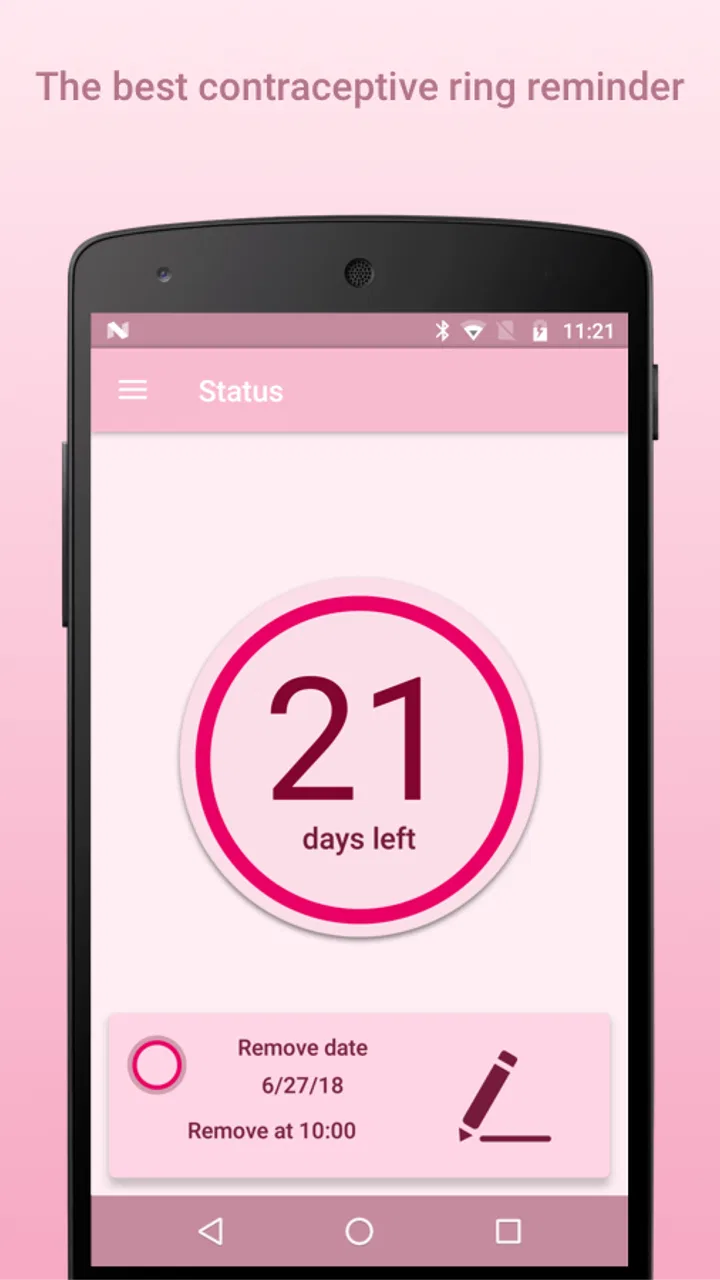
Contraceptive Ring Reminder +
- 3.8
- Rating
- 50.00K
- Installs
- Free
- Price

 Analysis by App-foxy
Contraception is often less difficult to understand than it is to remember. A ring can be simple to use, yet the replacement date can arrive during a busy week, while travelling, or when several other health tasks are competing for attention. That is the problem Contraceptive Ring Reminder + tries to solve. I approached it as a small medical reminder rather than a complete contraception service, and that distinction matters: its value depends less on novelty than on whether it quietly supports a routine over many months.
The app is free to get, with optional in-app purchases ranging from under a dollar to a few dollars per item. It is made by Cauim Tech and sits in the medical category, with an Everyone age rating. The current release is version 2.1.3, and it runs on Android 7.0 or later. Its average rating is 3.8 from around 1.4 thousand ratings, while the app has passed 50 thousand installs. Those figures suggest a useful but not universally loved tool: enough people have tried it to make it familiar, but the rating also encourages realistic expectations rather than blind enthusiasm.
What it feels like during the first week
My first impression is that the app addresses a very specific moment in a user’s routine: the point at which remembering the ring schedule becomes more important than reading about contraception. The appeal is immediate because a reminder can remove one small task from mental storage. Instead of repeatedly calculating when the next change should happen, I can let the app act as a prompt and return my attention to the rest of the day.
You May Also Like

 Blood Strike: 2.5 Anniversary
Blood Strike’s Loadouts Turn Every Drop Into a Tactical Gamble
A close look at Blood Strike’s custom loadouts: how fast access to signature weapons reshapes its battle royale rhythm, rewards preparation, and narrows the gap between fights.

 Pandora - Music & Podcasts
Pandora’s Music Is Easy to Start, but Harder to Recover
Pandora’s strength is its low-effort path from a seed to a station. Its weak spot is how much confidence it asks you to place in connection, setup, and quiet recovery.

 8 Ball Pool
 Is Built on Rivalries, Rematches, and Routine
A close look at the rivalries, rematches, shared routines, and unanswered safety questions that turn a quick pool match into a persistent mobile community.

 Samsung Music
’s Quiet Strength Is Playing What You Already Own
Its reach comes less from spectacle than from dependable access to a personal library. That simplicity is both the app’s strongest retention engine and its ceiling.

 AccuWeather: Weather Radar
AccuWeather Review: A Quick, Clear Forecast for Everyday Decisions
For everyday plans, the best forecast is the one you can understand quickly. AccuWeather makes rain timing, radar, and local conditions easy to act on, with a few trade-offs.

 Hill Climb Racing
Why Hill Climb Racing Still Turns Crashes Into One More Run
A tiny car, a bumpy hill and one more upgrade: Hill Climb Racing keeps resurfacing because its simple chaos makes every near-miss feel personal.
More From Our News Desk
View All News


That narrow focus is a strength. I would not open this expecting a broad period tracker, a medication encyclopedia, or a replacement for a clinician. The experience makes more sense when I treat it as a dedicated companion for a recurring ring schedule. A focused tool can be easier to trust than a crowded health app where the relevant reminder is buried among cycle charts, symptoms, articles, and unrelated notifications.
The first-week appeal also comes from the psychological relief of setting up a routine once. The important question is not whether a reminder looks impressive on its first day. It is whether I can understand what it is reminding me to do, recognize the alert at the right time, and avoid second-guessing the schedule. For a person who has already chosen a ring with professional guidance, that can be enough to justify installing a separate app.
I would still begin carefully. Before relying on any reminder, I would compare the schedule I enter with the instructions given by my healthcare professional and the product information for the specific ring I use. A reminder app can help with timing, but it cannot decide whether a particular method is medically suitable, explain every situation involving a missed or expelled ring, or replace advice about interactions and side effects. That boundary is especially important in a medical app.
A practical first use
Imagine someone changes their ring on a Sunday evening. The following weeks include work deadlines, a short trip, and a weekend away from home. The app’s useful role is not to make contraception more complicated; it is to provide a prompt before the next planned action becomes urgent. I would use the initial setup as a deliberate checkpoint: confirm the date, choose a time I am likely to notice, and keep the reminder connected to a routine such as brushing my teeth or preparing for bed.
That last step is an underrated habit trick. An alert that appears at an unpredictable or inconvenient moment is easy to dismiss. A reminder that arrives alongside a stable daily activity has a better chance of becoming automatic. The app cannot create that habit for me, but it can provide the cue. In my view, this is where its first-week usefulness becomes more practical than simply having a calendar note.
Another reason to avoid rushing is that the first alert is a test of visibility. If I am likely to miss notifications while the phone is silent, in a meeting, or in a bag, I should notice that immediately rather than discovering it on an important date. The right response is to adjust my phone’s notification behavior and personal routine, not to assume that an alert alone guarantees perfect adherence.
Why the value either grows or disappears month by month
Reminder apps are judged differently after the novelty fades. During the first few days, opening a new tool feels like progress. After several cycles, I want the app to become almost invisible: present when needed, quiet when not. That is the standard I apply here. The lasting value comes from reducing repeated mental calculation, not from giving me another screen to check every morning.
For someone who occasionally loses track of dates, the recurring nature of ring use makes a dedicated reminder more defensible than a one-off calendar entry. A general calendar can certainly handle a repeating event, and a phone alarm may be sufficient for users with a stable routine. The advantage of a purpose-built reminder is the context. When I see a notification tied to the contraceptive ring rather than a vague event labelled “change,” I am less likely to wonder what the alert means.
That advantage has limits. If I already maintain a reliable calendar system, use a general medication reminder, or receive support from another health routine, adding this app may create duplication rather than safety. Two reminders with different dates can be more confusing than one carefully maintained reminder. I would choose one primary system and use the other only if it clearly improves visibility.
The app is most valuable for users whose schedules change. A person with rotating shifts, frequent travel, irregular sleep, or a habit of postponing small administrative tasks may benefit more than someone who changes the ring at exactly the same time every cycle. In those cases, the reminder serves as an external memory aid. It does not need to be sophisticated to be useful; it needs to arrive at the moment when memory is most likely to fail.
Month-to-month value also depends on what happens after an interruption. Phones are replaced, settings are changed, and apps are sometimes ignored for weeks. I would not consider a reminder routine complete until I had checked that the next date still made sense after a missed alert or a change in schedule. The app can support continuity, but I remain responsible for verifying the event rather than treating the notification as unquestionable medical instruction.
Where it beats ordinary alternatives
A handwritten note has the benefit of being visible, but it does not actively prompt me. A standard alarm may ring, yet it can be too generic to explain the action. A calendar event is flexible and already available on many phones, but it may disappear among appointments and bills. A broad cycle-tracking app may offer more health context, although that extra information can make a simple ring reminder harder to find.
Contraceptive Ring Reminder + makes the strongest case when I want a dedicated place for this one recurring responsibility. Its trade-off is equally clear: a narrow tool has fewer reasons to open it outside the reminder itself. If I want symptom logging, broader reproductive-health planning, or a combined medication system, another category of app may fit better. I would not install this one merely because it is medical; I would install it because the ring schedule deserves a separate, recognizable cue.
There is also a privacy-related practical trade-off in using any health app. I would consider whether I am comfortable keeping this kind of reminder on my phone and whether other people might see its notification text. The safest setup is the one that is both private enough for my circumstances and noticeable enough that I will not overlook it. A reminder that is hidden completely may protect discretion while undermining its purpose.
How much maintenance it asks from me
The maintenance burden appears modest when the routine is stable, but “low maintenance” does not mean “set it once and forget it forever.” I would periodically check the next scheduled action, especially after changing phones, updating notification preferences, travelling across time zones, or altering the time of day when I usually manage the ring. These are ordinary moments when a reminder can become detached from real life.
The most useful maintenance habit is a quick confirmation whenever I act on an alert. I would not simply dismiss the notification and move on. I would make the change, then verify that the next reminder corresponds to the plan I am following. This takes only a moment, but it prevents the common problem of acknowledging an alert without completing the task.
That workflow is particularly helpful for people who sometimes postpone the action. If I dismiss a reminder because I am in public or away from home, I need a personal rule for handling it later. The app can prompt me, but it cannot know whether I completed the change, delayed it, or need medical guidance. Treating dismissal as completion is the wrong habit for any health reminder.
I would also keep the app in a location where I can find it quickly, even if I rarely open it. The purpose is not to browse. It is to make checking the schedule easy when I have a question. A small amount of organization at the beginning reduces friction later, especially when I am tired or travelling.
What can cause reminder fatigue
Repeated alerts can become background noise. This is the biggest long-term threat to an app like this. If every notification feels identical, arrives at an inconvenient time, or appears when I already know what to do, I may swipe it away automatically. The reminder then remains technically present but practically useless.
I would manage that risk by choosing a time with a realistic chance of attention rather than selecting the most convenient setup screen option. I would also avoid creating overlapping alerts in several apps unless there is a clear reason. Redundancy can help someone who routinely misses notifications, but too many similar prompts can train me to ignore all of them.
Another source of fatigue is uncertainty. If the app’s reminder does not clearly match the schedule I follow, I may spend more time checking it than I would have spent using a calendar. That is why I see the app as a memory aid, not as the authority on personal medical decisions. When the schedule changes because of a missed dose, illness, a ring problem, or professional advice, I would resolve the situation using reliable medical guidance and then update my routine deliberately.
People who dislike recurring notifications may find a general calendar less intrusive. Someone who wants a complete reproductive-health record may also become frustrated by the narrow purpose here. On the other hand, users who are tired of broad apps asking them to log everything may appreciate that this tool can remain focused on one recurring responsibility.
Who will keep using it after the novelty fades?
I think the app earns lasting space on a phone when the user has a genuine memory problem to solve: a changing schedule, a busy household, travel, shift work, or a tendency to postpone ring-related tasks. For that audience, the benefit is cumulative. Each successful reminder prevents another moment of uncertainty, and the app becomes part of a quiet monthly routine rather than an app I actively “use” every day.
It is less compelling for someone who already has an accurate, trusted reminder system and never misses a scheduled change. In that situation, the extra installation may add clutter without adding protection. I would also skip it if I expected medical explanations, personalized clinical advice, detailed tracking, or emergency support. Its role is narrower, and choosing it with that expectation makes the experience more satisfying.
The free starting price lowers the barrier to testing that fit, while the optional purchases mean I would pay attention to what I actually need before spending anything. I would not purchase extras simply because the app is related to health. The right question is whether a paid item meaningfully improves my routine and reduces the chance of overlooking an important reminder.
The app’s Everyone rating makes it broadly accessible from an age-classification perspective, but that should not be confused with universal medical suitability. Contraceptive choices are personal, and the reminder is useful only after the underlying method and schedule are appropriate for the individual. I would keep a clinician or pharmacist in the loop whenever I had questions about starting, stopping, changing, or correcting use.
After living with the idea of a dedicated ring reminder, my verdict is cautiously positive. Contraceptive Ring Reminder + does not need to entertain me or become a daily destination. Its success is measured by whether it stays dependable and unobtrusive across ordinary months. The app’s focused purpose is its clearest strength, while its narrow scope and dependence on my notification habits are the main reasons not everyone will need it.
My recommendation is simple: try it if remembering the ring schedule is a recurring source of stress, then judge it by the quality of the routine it creates rather than by how interesting it feels during the first week. Keep the schedule aligned with professional guidance, confirm each completed action, and avoid duplicate reminders that create confusion. If those habits fit your life, this small medical app can earn a permanent place on your phone. If your existing calendar already works perfectly, staying with that familiar system may be the better long-term choice.
FAQs for Contraceptive Ring Reminder +
01What is Contraceptive Ring Reminder + used for?
Contraceptive Ring Reminder + is designed to help users remember important dates related to a contraceptive vaginal ring, including insertion, removal, and replacement. After setting up a schedule, the app can provide notifications so you are less likely to forget a change. It is a reminder tool only and does not provide contraception, medical diagnosis, or protection by itself.
02Can I customize the reminder schedule for my contraceptive ring?
The app is intended to support different reminder routines by allowing you to enter or adjust dates and notification times according to your contraceptive plan. This can be useful if your healthcare professional has recommended a schedule that differs from the standard routine. Always check that the dates match the instructions for your specific ring and confirm any changes with a qualified healthcare provider.
03Does Contraceptive Ring Reminder + replace medical advice or contraception?
No. Contraceptive Ring Reminder + should not be considered a substitute for a doctor, pharmacist, or the official instructions supplied with your contraceptive ring. It cannot confirm whether the ring is positioned correctly, determine pregnancy status, prevent sexually transmitted infections, or advise you about side effects. If you miss a change, remove the ring unexpectedly, or have concerns, follow the product leaflet and contact a healthcare professional.
04Will the reminders work if I change phones or disable notifications?
Reminder reliability depends on your device settings. Notifications may not appear if alerts are disabled, the app is restricted from running in the background, battery-saving features interfere, or the app is removed during a phone change. Before relying on it, check notification permissions, sound and vibration settings, time-zone information, and battery restrictions. Keeping a secondary reminder, such as a calendar alert, can provide extra reassurance.
05Does the app protect my privacy and require an internet connection?
Before entering personal or health-related information, review the app’s current privacy policy and the permissions requested during installation. Reminder apps may store schedule details locally or use online services, depending on their design and settings. Internet access may be needed for downloads, updates, or optional features, while basic reminders may work offline. Avoid entering information you are uncomfortable sharing and keep your device protected with a passcode.
Pros
- Simple reminders help track ring insertion and removal dates.
- Custom schedules support different ring-use routines.
- Clear notifications can reduce the risk of missed replacement dates.
- Useful calendar view makes upcoming ring changes easy to check.
- Lightweight design requires little storage space or setup time.
Cons
- Reminder accuracy depends on allowing notifications to run in the background.
- It does not provide contraceptive protection or replace medical advice.
- Users must enter dates correctly for the schedule to remain reliable.
- Some features may require payment or contain advertising.
- It may not support every regional brand or prescription schedule.

Contraceptive Ring Reminder +
Gallery